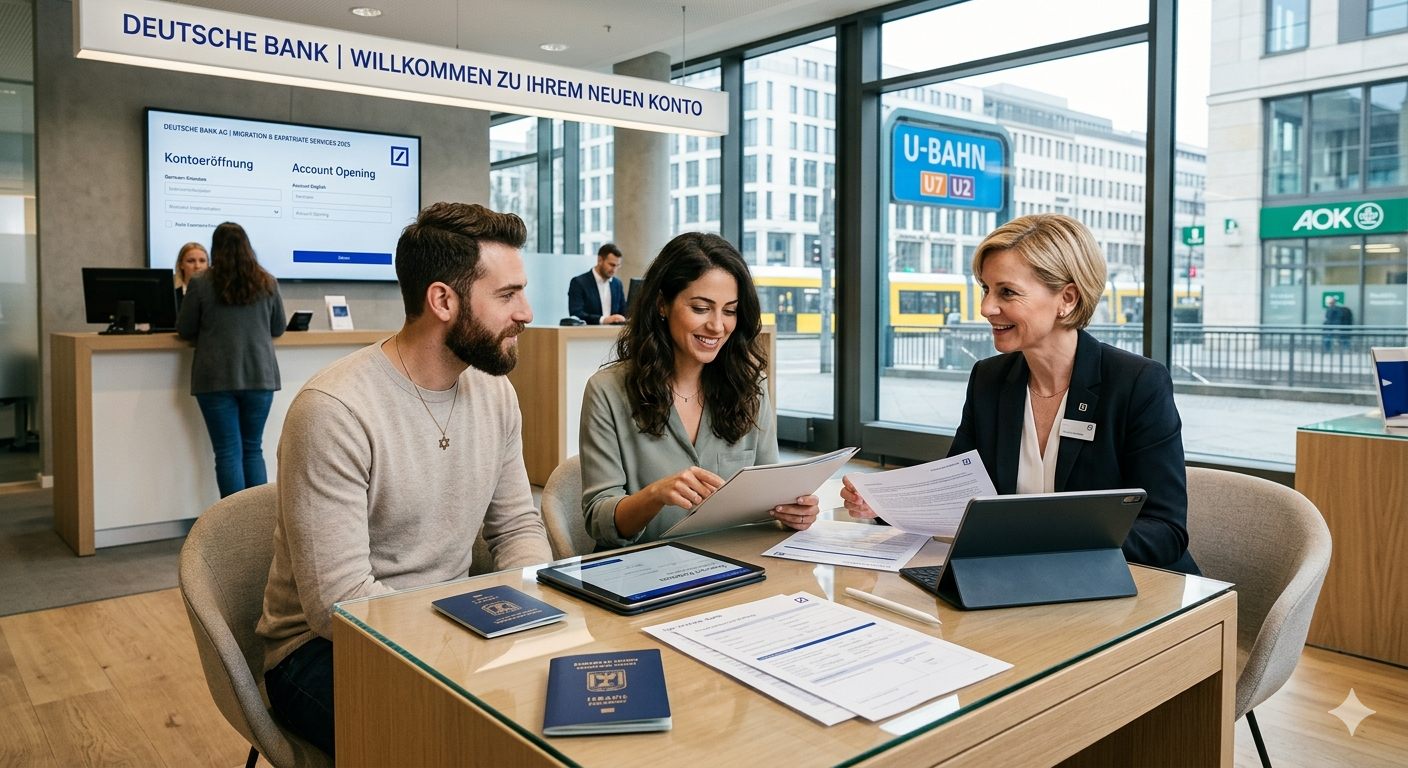
Opening a Bank Account in Germany 2026
Anmeldung, Schufa, N26 and Your First Month
This guide adapts the Hebrew Germany banking article into a global version for international newcomers. Germany often looks administratively clean from the outside, but banking is one of the first places people discover how much the system still depends on local registration, credit history, and paperwork sequencing.
The problem is not just "which bank should I choose?" The real issue is that many people arrive needing an account immediately for salary, rent, or daily payments, while the traditional banking system wants proof that they are already properly settled. That is why Germany feels circular in the first weeks: no address, no registration; no registration, no easy bank account.
The three blockers most newcomers hit
Anmeldung
In Germany, local address registration is foundational. Traditional banks often want proof that you are properly registered at your address before they will open a standard current account. In practice, this means your housing setup and your banking setup are often linked much more tightly than newcomers expect.
Schufa
Schufa is Germany's credit-reporting system. New arrivals usually do not have a bad score; they simply have no meaningful local file yet. But landlords, telecom providers, and banks often prefer established history over a neutral blank slate.
Language and branch culture
The Hebrew article correctly highlighted that some of the friction is cultural, not just technical. Digital providers are usually smoother and more English-friendly. Local branch banks can still be document-heavy, city-specific, and less comfortable in English.
Which account type makes sense first?
| Option | Best for | Main limitation |
|---|---|---|
| N26 | Fast first account, English-friendly app flow, salary landing | No branch network and some edge cases still need a more traditional bank later |
| Deutsche Bank | More conventional long-term setup with broad recognition | Usually stronger document expectations |
| Sparkasse | Local branch presence and very traditional German banking | Varies by city and often feels least newcomer-friendly |
| Commerzbank | Employees with a straightforward work-contract profile | Less useful if your paperwork chain is incomplete |
| Bunq / other EU app-first options | Flexible backup or bridge account | Not always ideal when a specifically German setup is expected |
N26 and digital-first solutions
The source article positioned N26 as the easiest first stop for many newcomers, and that remains a useful rule of thumb. If your priority is getting a functional euro account quickly, app-first providers are often much less painful than traditional branches. They are especially helpful during the arrival phase when your registration, lease, and local paperwork are still in motion.
That said, "easy to open" does not automatically mean "ideal forever." Some people eventually want a more traditional German bank for mortgage conversations, rental reassurance, cash-heavy situations, or simply peace of mind.
Traditional banks: better later than on day one
Deutsche Bank, Commerzbank, and local Sparkasse branches can all work well once your German life is more settled. If you have your registration, a stable address, and an employment contract, the experience is usually much smoother than it is during the chaotic arrival stage.
The key lesson from the Hebrew source is sequencing: do not make your entire first month depend on a traditional branch saying yes immediately.
What documents should you prepare?
- Passport or accepted ID for the initial account-opening process.
- Address registration evidence when using a bank that expects local registration.
- Lease or proof of residence if requested as part of compliance checks.
- Employment contract or income evidence for more traditional banking relationships.
- A working phone and video-ident setup if you plan to use app-first onboarding.
How to build Schufa from zero
Schufa gets a mythic reputation, but the practical lesson is simple: you build it by functioning normally and consistently in the German system. A stable bank account, properly paid bills, and time matter more than trying to game it.
- Open a legitimate account and use it consistently.
- Pay telecom and utility obligations on time.
- Avoid unnecessary credit applications in a short period.
- Treat buy-now-pay-later products carefully in the first year.
Your first bridge: Wise or Revolut
One of the most useful points in the Hebrew article is still one of the best arrival hacks: set up a flexible cross-border account before you move. Wise or Revolut can make the transition much easier while you are waiting for your German setup to stabilize.
These are not always perfect substitutes for a fully local German banking relationship, but they are excellent for reducing first-month friction. They buy you time, keep money moving, and prevent the classic problem of arriving with no practical receiving account at all.
The cleanest arrival sequence
- Open a flexible cross-border account before the move.
- Use a digital-first account for the first functional landing in Germany.
- Complete registration and address formalities as fast as possible.
- Upgrade into a traditional bank later if your situation really benefits from it.