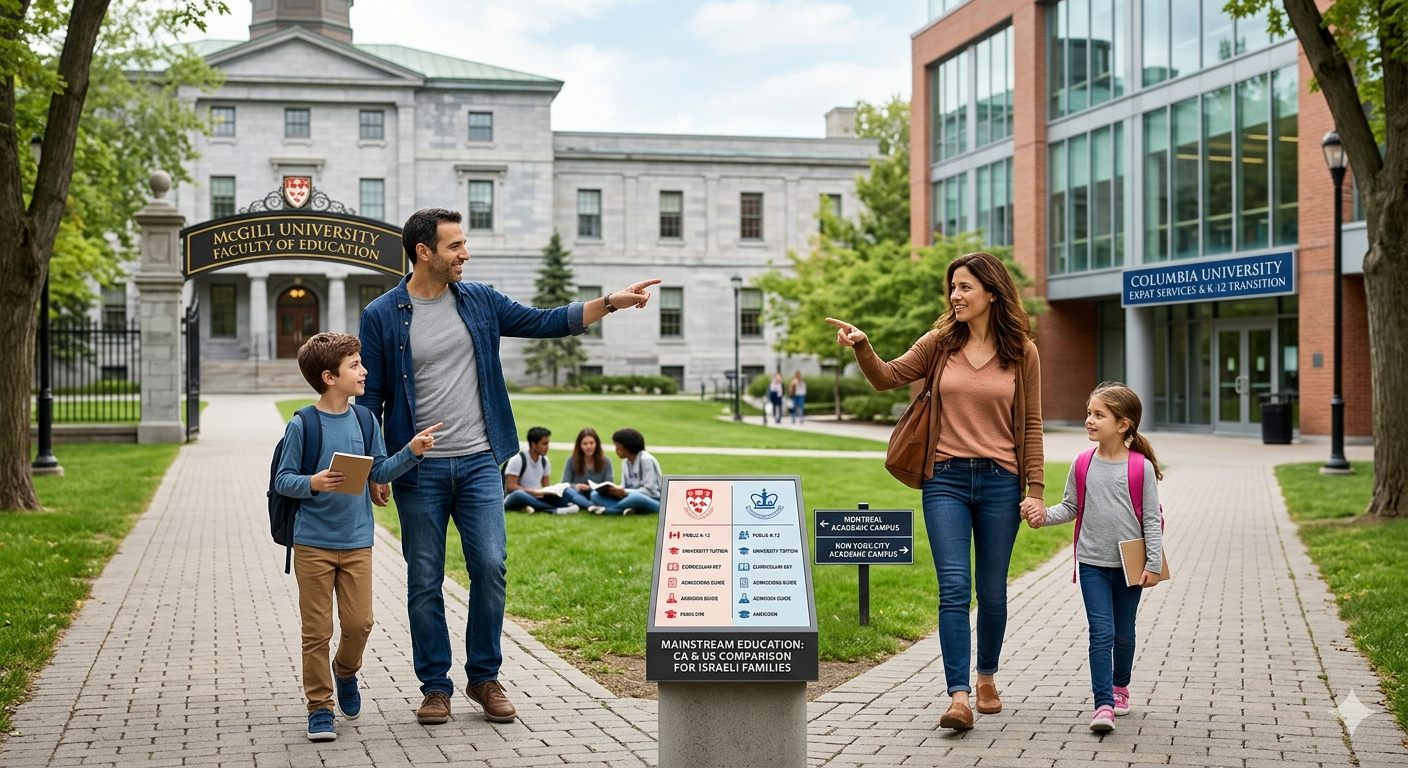
Canada vs USA Education Costs 2026
Childcare, Public Schools, Private Schools and University
This guide adapts the Hebrew Canada vs USA education article into a global version for international families. If you are deciding between the two countries, education is one of the biggest long-range budget variables and one of the easiest costs to underestimate.
For families, the cost comparison is not just about tuition. It is about how childcare, school quality, neighborhood selection, after-school life, and university funding interact over 15 to 20 years. That is why two families with similar salaries can feel financially relaxed in one country and chronically squeezed in the other.
Childcare is the first major fork
The Hebrew source article started where most young families feel the pressure first: early childcare. That is still the right starting point. Before children reach school age, the difference between Canada and the U.S. often shows up less in ideology and more in monthly cash flow.
Canada
In major Canadian cities, full-price daycare can still be expensive, especially before access to subsidized spaces. But the country has more public-policy momentum toward reducing the cost burden, and for families who actually access subsidized childcare, the savings can be dramatic.
United States
In the U.S., childcare is often one of the harshest family-budget lines, especially in expensive metro areas. Even where public pre-K options exist, availability, eligibility, and convenience can vary. In practical planning terms, many internationally mobile families should assume a higher and more volatile childcare budget in the U.S.
Public schools: Canada is more uniform, the U.S. is more location-sensitive
Public K-12 schooling is where the two countries begin to diverge structurally. Canada is often easier to model because school quality is more consistently usable across a wider range of neighborhoods. The U.S. can offer excellent public schooling too, but the quality gap between locations is much wider and often tied directly to housing cost.
| Area | Canada | United States |
|---|---|---|
| Public-school consistency | Generally more predictable across mainstream neighborhoods | Much more dependent on district and address |
| Hidden education cost | Often lower housing premium for decent schools | Good school districts can require much higher rent or home prices |
| Budget clarity | Easier to model long term | Can look free on paper but expensive through housing choices |
The source article captured this well: in the U.S., some of the real education cost is hidden inside the rent or mortgage you need to pay to access the right district. That is still one of the most important truths for global families comparing the two systems.
Private and faith-based schools
If your plan depends on private schooling, the gap often widens again. In both countries, private education can be a major long-term budget line, but the scale of premium private-school pricing in top U.S. cities can be especially intense.
The Hebrew source focused on Jewish school options because that matters for its original audience. For the global version, the broader lesson is the same: if you need a specific religious, bilingual, international, or high-prestige private-school environment, the U.S. usually offers enormous choice but often at a significantly higher price point.
University is where the long-range gap can become huge
The source article's strongest point is still one of the biggest strategic differences between the countries: higher education can produce a dramatically different long-term financial story. For many families, the real Canada vs U.S. question is not today's daycare bill but what undergraduate years will eventually cost.
Canada can still be expensive for university, especially for international students before permanent status, but the public university model is generally easier to plan around than the top-end U.S. private and out-of-state system. In the U.S., outcomes can range from manageable to extremely expensive depending on state residency, school type, scholarships, and family income.
| Stage | Canada | United States |
|---|---|---|
| Childcare | Can be expensive, but subsidies may change the picture a lot | Often higher and less predictable in expensive metros |
| Public school | Stronger baseline consistency | More district-driven and housing-driven |
| Private school | Can still be expensive | Often materially higher at the premium end |
| University | Usually easier to model | Can vary from reasonable to extremely costly |
Which country fits which family?
- Canada fits better if you want more predictable family budgeting, stronger baseline public education, and a lower chance that schooling choices force you into a much more expensive housing bracket.
- The U.S. fits better if your career upside, university ambitions, or preferred private-school ecosystem outweigh the higher cost volatility.
There is no single winner for every household. But if your goal is to reduce long-range family financial stress, the Hebrew article's core conclusion still translates well globally: Canada is often the calmer, easier-to-budget family choice, while the U.S. offers more upside and more financial dispersion.